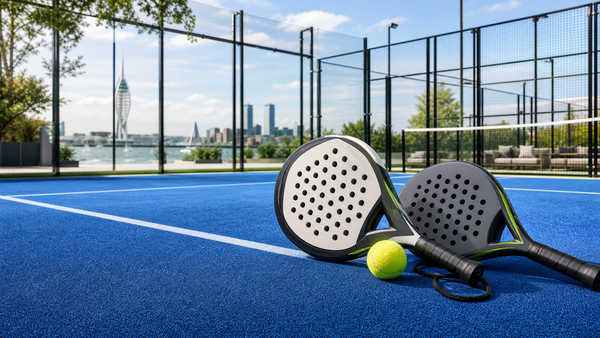
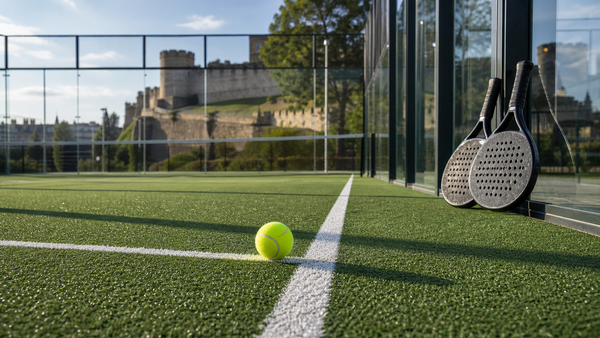
A standard doubles padel court is 20m long and 10m wide, enclosed by walls and fencing, with a net across the middle. That compact size is why padel feels quick, social and playable before you have tennis-level court coverage.
Last updated: 24 June 2026. Dimensions were checked against the International Padel Federation rules documents and LTA padel construction guidance. For competition, construction or planning decisions, use the official documents rather than a blog article. Even this one.
Padel court dimensions at a glance
| Feature | Standard doubles court | What it means |
|---|---|---|
| Length | 20m | Back wall to back wall |
| Width | 10m | Side wall to side wall |
| Net width | 10m | Runs across the court at the centre |
| Net height | 0.88m at the centre | Can be slightly higher at the sides under official tolerances |
| Back rebound height | Typically 4m total | Commonly 3m rebound surface plus 1m mesh |
| Singles court | About 20m by 6m | Less common than doubles courts |
Why is a padel court smaller than a tennis court?
Padel is designed around shorter reactions, doubles positioning and walls. The court is smaller than tennis, but the walls keep the rally alive. You do not simply run side to side chasing every ball into the corners. You learn when to let the ball bounce off the glass and when to step forward.
That is why padel can feel easier to start than tennis but still hard to master. The court helps beginners rally. The walls then spend the next few years reminding you that timing is a real thing.
How is the court laid out?
The net splits the court into two halves. Each side has service boxes marked by service lines and a central service line. The serve is underarm and hit diagonally into the opposite service box.
After the serve and normal bounce rules, the walls become part of the game. The ball may rebound off the glass or mesh after it has bounced correctly in the court.
What are the walls and fencing for?
The enclosure is not just there to stop balls annoying the next court. It is part of the sport.
LTA construction guidance explains that padel courts need rebound ends with fencing to a total height of 4m. The first 3m can be transparent or solid material, including glass, provided it does not affect the ball’s bounce. The top 1m is mesh.
That matters to players because different surfaces feel different. Glass gives a cleaner view and a consistent rebound when properly installed. Mesh can create more awkward bounces. Both are part of learning the game.
How high is a padel net?
The LTA guidance gives the net as 10m wide and 0.88m high at the centre. Official rules allow the net to be slightly higher at the sides. In player terms, it is low enough that touch, placement and lobs matter more than simply smashing through the court.
How much space does a venue need?
The playing court is 20m by 10m, but a venue needs more than that. It has to allow for the structure, access, safety, drainage, lighting and sometimes out-of-court play areas for higher-level competition.
That is one reason UK padel courts can be expensive to build and hire. The visible court is only part of the project.
Does every court feel the same?
No. The official size may be standard, but the playing experience can vary with surface, lighting, roof height, glass quality, weather, spacing between courts and whether the venue is indoor, outdoor or covered.
For beginners, the biggest differences are grip underfoot, visibility and how predictable the glass feels. If you are booking somewhere new, check whether it is indoor or outdoor and whether rackets are available to hire.
What should beginners notice on court?
- The court is compact: rallies happen quickly, so recovery position matters.
- The walls are playable: do not panic every time the ball passes you.
- The net is low: controlled volleys and lobs matter.
- The corners are tricky: glass and mesh rebounds need patience.
- Doubles positioning matters: two players should move as a pair, not as two solo acts.
Kit and booking next steps
If you are booking your first court, ask whether rackets and balls are included. If you are buying kit, start with a forgiving racket and simple accessories from padel rackets and padel accessories.
For related rules context, read can you play singles padel? and why padel courts are made of glass.
FAQs
How big is a standard padel court?
A standard doubles padel court is 20m long and 10m wide.
How high is a padel net?
The net is 0.88m high at the centre and spans the 10m court width.
Is a padel court smaller than a tennis court?
Yes. A padel court is smaller and enclosed, with walls that form part of play.
What size is a singles padel court?
A singles court is commonly referenced as 20m by about 6m, but singles courts are much less common than standard doubles courts in the UK.
Are the walls part of the court?
Yes. After the ball has bounced correctly, players can use the walls as part of the rally.
Do padel courts need glass?
They need rebound surfaces. Glass is common because it gives visibility and a consistent bounce when properly installed, but official construction guidance also recognises other rebound materials.