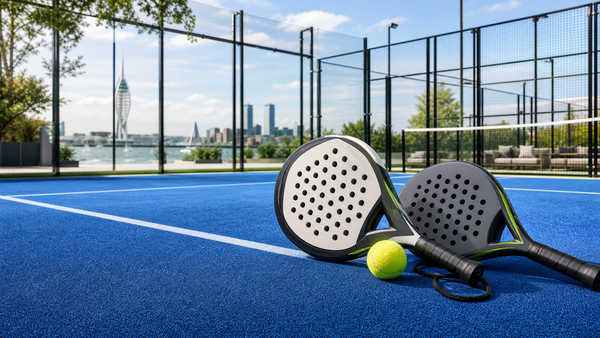
Quick answer: padel and squash both use walls, but they are not close substitutes. Padel is usually a doubles game on a 10m by 20m enclosed court with a net, underarm serve, tennis-style scoring and wall rebounds after the ball has bounced. Squash is usually singles on a smaller four-walled court, with both players sharing the same space and hitting to the front wall.
Last updated: 24 June 2026. This comparison was checked against the International Padel Federation Rules of Padel effective from 1 January 2026, World Squash singles rules, LTA padel participation reporting and England Squash beginner guidance.
Padel vs squash at a glance
| Feature | Padel | Squash |
|---|---|---|
| Court | 10m by 20m enclosed court with glass and mesh walls | Four-walled court shared by both players, with shots played to the front wall |
| Common format | Usually doubles | Usually singles |
| Net | Yes, across the middle of the court | No net; the front wall is the target |
| Serve | Underarm serve after a bounce, played diagonally | Serve to the front wall from a service box into the opposite quarter court |
| Scoring | Tennis-style games and sets | Point-a-rally scoring, commonly to 11 points and best of 5 games |
| Beginner feel | Social, accessible and tactical once the glass makes sense | Fast, intense and technically simple to start, but demanding to sustain |
Are padel and squash the same?
No. The wall element is the obvious overlap, but the games feel very different once you start playing.
In padel, the ball must land in the opponent's court before wall play normally becomes useful. You are trying to pass, lob, volley and use the glass with a partner. In squash, both players share the same court and take turns striking the ball to the front wall. That shared space is why lets, strokes and interference rules matter so much in squash.
If you are completely new to padel, start with what padel is and then read padel rules explained for scoring, walls and common faults.
Which is harder for beginners?
Padel is often easier for a first social session because the serve is underarm, doubles is standard and rallies can start quickly. The hard part comes later: judging rebounds, moving as a pair and knowing when to attack instead of hitting every ball as if it owes you money.
Squash can be simple to understand - hit the front wall above the tin and keep the rally alive - but the pace is less forgiving. You need repeated short bursts, quick turns and good awareness of your opponent because you are sharing the court.
The practical answer is: padel is usually easier to enjoy on day one, squash can feel tougher physically from the start, and both become much deeper once you play people who know what they are doing.
Which gives the better workout?
Both can be a strong workout, but in different ways. Squash is known for repeated acceleration, lunging and recovery in a small space. Padel tends to be more stop-start doubles movement, with rallies built around positioning, lobs, volleys and wall reads.
This is not medical advice and it should not be sold as a guaranteed fitness result. Intensity depends on your level, match pace, session length, breaks, age, fitness and whether you are playing singles-style drills or relaxed doubles. If you are returning from injury or have health concerns, get proper advice before treating either sport as a fitness programme.
Rules differences that matter
- Padel has a net. Squash has a front wall target instead.
- Padel uses tennis-style scoring. Squash uses point-a-rally scoring, commonly to 11 points.
- Padel is usually doubles. Squash is usually singles, though doubles versions exist.
- Padel wall play follows the bounce. Squash wall play is central to almost every rally.
- Squash has interference decisions. Lets and strokes are part of keeping shared-court play fair and safe.
Which sport is more popular in the UK?
The safest claim from the checked sources is that padel currently has very clear growth evidence in Britain. The LTA reported that padel participation doubled during 2025 to 860,000, courts in Britain rose to more than 1,500 and participation has since passed 1 million players.
Squash remains established, with England Squash pointing players towards ways to play, beginner sessions and more than 4,000 courts in England. This article should not invent a direct national participation comparison where the sources use different measures.
Which should you try first?
- Try padel first if you want a social doubles game, a gentler first serve and a sport that rewards teamwork as much as raw speed.
- Try squash first if you like fast rallies, direct competition and a compact game that asks plenty from your legs.
- Try both if you can. Padel teaches patience and angles with a partner; squash teaches movement, anticipation and tidy contact under pressure.
What kit do you need?
For a first session, hire or borrow if the venue allows it. If you keep playing padel, you need a padel racket and proper balls. A squash racket is not a padel racket, and a padel racket is not a squash racket. Obvious, yes. Still worth saying.
If padel is the route you want, browse padel rackets or the wider racquet sports range. For practical buying help, use the padel gear guide. If grip comfort is your first issue, racket overgrips are a useful low-cost place to start.
Want help choosing your first court sport?
Use the Darts Connect email form at the bottom of the home page and ask for the court-sport chooser. Until article-level sign-up is approved, that is the clean fallback route.
FAQs
Is padel more like squash or tennis?
Padel is closer to tennis in scoring and net structure, but it borrows the wall-rebound idea that makes squash feel familiar. It is still its own sport.
Is squash harder than padel?
For many beginners, squash feels harder physically because of the speed and repeated movement in a small space. Padel is usually easier to enjoy socially at first, but wall judgement and doubles tactics become challenging.
Can squash players play padel?
Yes. Squash players often bring good reactions, wall awareness and movement habits. They still need to adjust to the net, doubles positioning and tennis-style scoring.
Can you use a squash racket for padel?
No. Padel uses a solid, perforated padel racket. Squash uses a strung racket. Use the correct kit for the sport and venue.
Which is better for fitness?
Neither is automatically better for every player. Squash often feels more intense in short bursts, while padel can give a strong doubles workout. The real answer depends on pace, session length and your fitness.
Is padel safer than squash?
Do not assume that. Padel may feel less frantic at beginner level, but both sports involve quick movement and potential contact or strain. Start at the right level and follow venue guidance.
Sources
- International Padel Federation: Rules of Padel, effective 1 January 2026
- World Squash Officiating: rules of squash
- World Squash: Singles Rules 2025
- LTA: Annual Report and Accounts show growth of tennis and padel in 2025
- England Squash: rules and regulations
- England Squash: play squash
Sources checked 24 June 2026.