Quick answer: padel can be noisy, but it is not honest to say it is always louder or quieter than pickleball without matching the measurement method, distance and sound metric. Pickleball is known for sharp paddle pops. Padel adds racket impacts, ball rebounds, glass and fence noise, player calls and a court enclosure that can shape how the sound travels.
The useful question is not just “which sport is louder?” It is whether nearby people hear repeated impacts, whether those impacts stand out above background noise, and whether the court design gives the sound somewhere sensible to go.
Why the comparison is awkward
Noise studies do not all measure the same thing. A reading taken courtside is not the same as a reading at a neighbouring garden. A peak impact is not the same as an average exposure over an hour. A sound that looks modest as an average can still be annoying if the repeated impact has a sharp character.
That matters for padel and pickleball because both games create repeated contact sounds, but they do it through different equipment and playing spaces.
What makes pickleball sound distinctive?
Pickleball uses a hard paddle and a perforated plastic ball. The contact can produce a crisp, high-pitched pop that carries clearly, especially when several courts are active at once.
A peer-reviewed pickleball noise study reported average and peak measurements around active courts, but those figures apply to that study's locations, equipment, distances and methods. They are useful evidence for pickleball noise exposure. They are not a direct padel comparison by themselves.
What makes padel noisy?
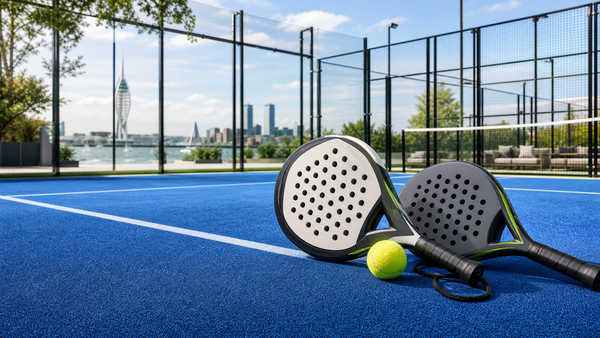
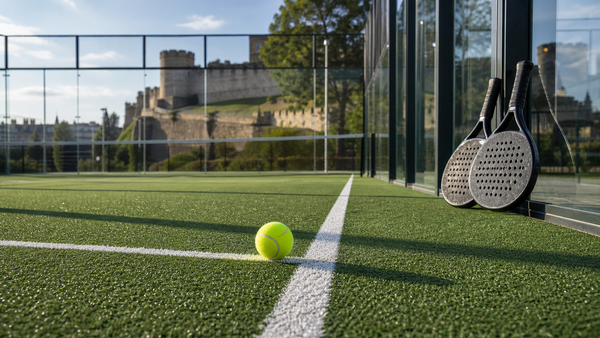
Padel uses a solid perforated racket, a pressurised ball and an enclosed court with glass and mesh. The obvious sounds are racket impact, the ball hitting the glass, fence rebounds, shoes, calls and the rhythm of doubles rallies.
The enclosure is part of the sport. It is also why padel noise planning tends to care about court siting, barriers, glass, surrounding buildings and how close the court sits to homes or quiet outdoor space.
Peak impact, average exposure and annoyance
There are 3 different ideas worth separating:
- Peak impact: the loudest short contact, such as a paddle pop, racket strike or wall rebound.
- Average exposure: the sound energy over time, often affected by how many players, courts and rallies are active.
- Annoyance: how noticeable, repetitive or intrusive the sound feels to people nearby.
A court can have a manageable average level and still irritate neighbours if the impact sound repeatedly cuts through the background. That is why acoustic design should happen before a court is squeezed into a tight site.
So, is padel as noisy as pickleball?
The fairest answer is: both can be a noise problem, but the evidence does not support a lazy universal winner. Pickleball has a distinctive paddle-ball pop. Padel has an enclosed court with glass and rebound sounds. Which is more intrusive depends on the court design, distance, number of courts, surfaces, barriers, background noise and how the measurement is taken.
If you are choosing where to play, this mostly means being considerate around residential sites. If you are planning courts, it means commissioning proper acoustic advice rather than relying on one headline decibel number from another sport.
What can clubs and players do?
- Put courts away from sensitive boundaries where possible.
- Use acoustic assessment before installation, not after complaints start.
- Manage playing hours where courts sit close to homes.
- Use screens, barriers or site layout changes only where an acoustic specialist supports them.
- Keep player behaviour sensible, especially early and late in the day.
For players, the practical job is simpler: respect venue rules, avoid unnecessary shouting and understand that repeated impact noise travels further than it feels from inside the rally.
Where to go next
If you are new to the sport, start with what padel is and why it is growing. For the court itself, read padel rules and court basics. If you are comparing sports, our pickleball versus padel guide explains the wider differences.
Equipment comes later in this journey. When you are ready, the padel gear guide is a better next step than buying from one noise claim.
For more court-sports explainers, join the Darts Connect email list through the email sign-up form.
Sources
Sources checked 21 June 2026.