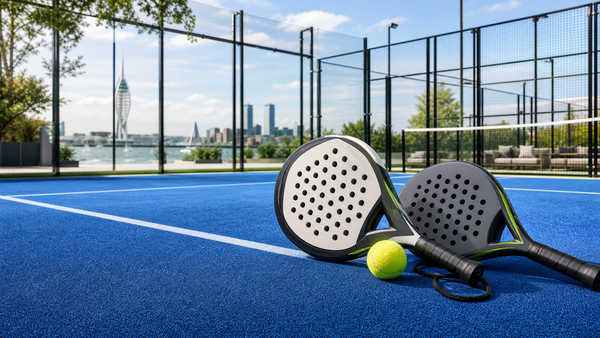
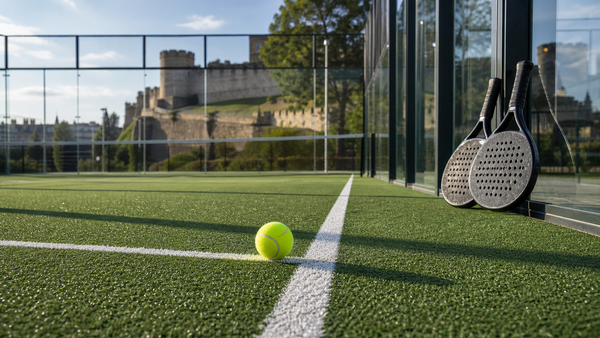
To return serve in padel, stand behind the service line, give yourself room for the rebound and aim for a safe, low return rather than a winner. Your first job is to get the point started without handing the serving team an easy volley.
The current article should be about receiving serve, not explaining how to serve. The serve matters, of course, but the returner has a different problem: read the bounce, decide whether to use the wall and play a sensible ball under pressure.
Where should you stand to return?
Start behind the service line, slightly inside the side wall, with enough room to move forward or let the ball reach the glass. Your exact position depends on the server, court speed and whether you prefer taking the ball early.
As a beginner, avoid standing too far forward. If you crowd the bounce, a deeper serve can jam you. Avoid standing glued to the back glass as well, because short serves will drag you forwards in a hurry.
Return positioning checklist
- Stay balanced with your racket ready in front.
- Give yourself space from the side wall.
- Watch the server's contact and the ball bounce.
- Know before the point whether you are comfortable using the back wall.
- Agree with your partner who receives from each side.
Do you have to let the serve bounce?
Yes. In padel, the returner must let the serve bounce before playing it. If the serve is legal and then hits the side or back wall after bouncing, it remains playable. If it hits the fence after the bounce on serve, that is normally a fault.
For casual games, check the local competition format if anything feels unclear. The International Padel Federation rules are the formal reference, but beginner sessions may explain things more simply.
Should you use the wall on the return?
Use the wall when the serve is deep enough and you have time. Letting the ball come off the glass can give you a cleaner contact point than rushing a cramped shot near your body.
Take it before the wall when the serve is shorter, slower or sits nicely in front of you. The decision is not about bravery. It is about which contact point gives you control.
Best return targets for beginners
Your return does not need to win the point. It needs to avoid losing it immediately.
| Target | Why it works | Risk |
|---|---|---|
| Low through the middle | Creates doubt between opponents | Can sit up if hit too soft |
| Cross-court deep | More court to aim at | Needs enough height and control |
| Lob over the net player | Can move opponents back | Short lobs get punished |
| Low at the server's feet | Harder for them to attack | Higher net risk |
What to avoid
- Trying to hit a winner. The return is usually a neutralising shot.
- Standing too close to the wall. You need space for the rebound.
- Changing direction too hard. It raises the error risk.
- Forgetting the net player. A floating return is an easy volley.
- Copying advanced players too soon. Learn the safe return first.
Partner movement after the return
Once the return is in, recover with your partner. If you hit a good lob and push opponents back, move forward together. If your return is defensive, stay patient and prepare for the next ball.
Calling early helps. Use simple words like mine, yours, leave and lob. You are not commentating the point. You are preventing a tiny doubles tragedy.
Simple return drill
- Server hits 10 serves to the same side.
- Returner plays 5 before the wall and 5 after the wall.
- All returns must go low through the middle or cross-court deep.
- Swap sides and repeat.
- Add a net player once the returner can make 7 out of 10.
If you need a more comfortable setup, browse padel rackets for controllable options and racket overgrips if the handle is slipping during returns.
The sensible next step
In your next match, stop judging your return by whether it wins the point. Judge it by whether it makes the server play a difficult next ball. That is a better padel habit and a much less dramatic way to improve.
FAQs
Where do you stand to return serve in padel?
Stand behind the service line with enough room to move forward or let a deep serve reach the back wall. Do not stand too close to the side or back glass.
Can you volley a serve return in padel?
No. The serve must bounce before the receiver returns it.
Can a padel serve hit the wall?
After a legal bounce in the service box, the ball can hit the side or back wall and remain playable. If it hits the fence after the bounce on serve, it is normally a fault.
What is the safest padel return?
A low return through the middle or a controlled cross-court return is usually safer than trying to hit a winner. A deep lob can also work if you have enough control.
Should I return before or after the wall?
Return before the wall when the serve sits up or is short. Use the wall when the serve is deep and the rebound gives you more time and space.
Sources and further reading
Sources checked 21 June 2026.